Soundproofing is likely to become a modern necessity, rather than a nicety, as urban centers and populations continue to grow. If you’re ready to knock out noise pollution at your house, upgrading to soundproof windows is a great place to start — but it’s not the whole picture. Let’s take a look at how sound abatement windows work, along with the other components that impact the amount of outside noise that gets into your home.
Types of Soundproofed Windows
Without getting too technical, here’s how sound transmission is measured (so you can easily compare types of windows and gauge what’s best for you). Experts use the Sound Transmission Coefficient scale, or STC scale, where a unit with a higher STC blocks noise better than a unit with a lower STC. Most windows have an STC rating between 20 and 50, with 50 being the window that blocks the most noise.
Here’s some other important window soundproofing terminology before we get into the details:
- • Standard (single-paned) windows. Single-paned windows are the least soundproofed windows out there, and tend to appear only in homes built before 1970. These windows can have an STC rating as low as 20, and often need to be replaced or improved by use of a window insert to make them more soundproof.
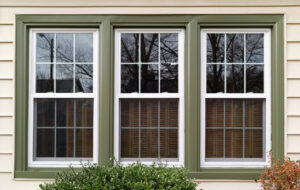
- • Double-paned windows. Double-paned windows tend to have a significantly higher STC rating than their single-pane counterparts, and often feature dissimilar glass, or two different types of glass, that help to absorb noise. Double-paned or triple-paned windows are now the standard in modern construction, and tend to have an STC rating that ranges from 25-50. You can tell if a window is double-paned or triple-paned simply by looking at it: there will often be a bit of space between each of the panes.
- • Energy efficient windows. In order for a window to be considered energy efficient, it must have at least two window panes and high-quality frames. It’ll also have either argon or krypton gas filled in between the panes that acts as insulation. These windows are great for both soundproofing and keeping your energy bills low year-round.
- • Laminate Windows. Laminate windows feature two layers of glass with a layer of plastic between them. These tend to be more expensive than double-pane windows, but they’re definitely the most effective windows available today for blocking sound.
- • Window inserts. Window inserts are handy additions to single-pane windows that you install on the inside of your window. They sit about five inches away from the main window, creating an air pocket that absorbs outdoor noise. Window inserts are a great alternative to replacing your windows, since they’re far cheaper to add than it would be to replace your windows entirely. There’s one caveat, though — while these are great to improve the STC of standard (single-paned) windows, these won’t do much to improve upon existing double-paned windows.
How Noise Gets Into Your House
Sound doesn’t just travel through your window panes; it sneaks through the same areas where air infiltrates through, and it moves through other physical components of your house, as well.
When you’re looking at reducing noise inside your house, windowpanes are only part of the equation. Everything from environmental factors to how your windows are installed to your walls and insulation plays a role in the amount of noise pollution that gets into your house. Here’s a rundown of each.
Window frames and installation methods
We’ve already talked about the different types of window panes out there, but there’s more to the window than just the glass. Everything from your window frame type to the installation method impacts how soundproof your windows are. Ensure there aren’t any gaps in your windows, and if there are, caulk the perimeter of your windows with acoustic sealant. If you’re installing new windows, it’s worth it to have an expert ensure they’re installed squarely to prevent air (and noise) leaks.
Environmental factors
Perhaps it should go without saying, but more sound will leak in through a window that faces a busy highway versus a window that opens to your backyard oasis. While you can’t control the nuisance of rush hour traffic outside your home office window, there are some environmental changes you can make to soundproof your home. Plant trees and bushes, put up a privacy fence, or get creative with your interior decorating (check out sound dampening curtains or acoustic panels, for instance) to help absorb sound so less of it gets into your home.
Wall insulation
The insulation of your walls plays a key role in the transmission of sound into your home. A typical insulated wall in a modern home has an STC between 35-42, while an old-fashioned lath and plaster wall has a higher STC rating — usually closer to 50.
So why does the STC rating of your walls matter when you’re focused on soundproofing your windows? It’s because your windows can only do so much to block out noise if your walls are lower on the STC scale.
Here’s an example. Let’s say your house was built in 1980. Your drywall and insulation have an STC rating of 35, and you’re looking to replace your windows with a more energy-efficient (and soundproof) option. Should you spend the extra thousands it would take to get top-of-the-line laminate windows with an STC rating of 50?
Probably not! With your walls having an STC rating of 35, it won’t make much of a difference in soundproofing if your windows are rated 35 or 50 (but it will make a huge difference in your budget). A good rule of thumb is to pick out windows that match the STC rating of your walls. You could always opt for expensive windows with a very high STC rating, but if your walls aren’t adequately soundproofed by comparison, you likely won’t notice that much of a difference between those higher-rated windows and their more economical counterparts.
There are so many considerations when it comes to soundproofing your windows, which is why we’re here. Contact the experts at Open and Shut KC today; we’d love to help. Call 913-586-OPEN or visit us at https://www.openandshutkc.com/ to get a free quote.